

417 Hz Frequency for Sleep: The Change Tone (2026)
417 Hz is the Solfeggio tone for change and clearing old patterns, a fitting sound for a calmer bedtime habit. Learn how to use it. Try free in Momental.
By Momental · · 8 min read
What is the 417 Hz frequency, and is it good for sleep?
417 Hz is a lower-mid Solfeggio tone traditionally associated with change, clearing, and moving out of stuck patterns. It sits in a warmer, less bright range than the high tones, so it is easy to listen to at night. Its real strength for sleep is as a repeatable cue in a routine you are trying to change.
What "change" and clearing old patterns mean for 417 Hz
In sound-healing tradition, 417 Hz is the "undoing" or "change" tone, the frequency people play when they want to break a loop and start something cleaner. It is described in terms of clearing away old patterns and making room for a new rhythm. Those are listening cues that set an intention, not a description of anything happening in your body.
There is no settled science behind the meaning, and 417 Hz will not cure anything. But the framing is genuinely useful, because sleep is often a habit problem more than a sound problem. If you attach a specific tone to the moment you decide to wind down, you give your brain a clear signal that the day is closing. For where 417 Hz sits among all nine tones, see the Solfeggio frequencies for sleep guide, and compare it with its neighbor 396 Hz, the "release" tone.
What 417 Hz actually is
A hertz is one vibration per second. A 417 Hz tone moves the air back and forth 417 times every second, and your ear turns that speed into pitch. On a piano, 417 Hz lands almost exactly on G♯4, the black key just above the G above middle C. It is a comfortable singing pitch for most voices, which helps explain why it feels familiar rather than piercing.
That slower wave is the practical difference. Next to the glassy top of the Solfeggio list, 417 Hz has rounder edges, so it can sit in a quiet bedroom without drawing your ear to it.
417 Hz benefits: what the research says
- Untested417 Hz clears old patternsA sound-healing meaning. No study has put it to the test.
- WeakSolfeggio-tuned music eases stressThe only pilot used 528 Hz music with nine people. Nothing on 417 Hz.
- PromisingCalming music helps you sleepA Cochrane review of 13 trials found music may improve self-reported sleep.
No one has studied 417 Hz on its own. The nearest Solfeggio evidence is a 2018 pilot on 528 Hz music, and the broader 2022 Cochrane review looked at relaxing music in general. So the fair claim is modest: a gentle tone you enjoy can be part of a wind-down that works, while the "change" meaning stays a story you choose to use.
Using 417 Hz to build a calmer bedtime habit
The most practical way to use 417 Hz is as a trigger. A habit needs a cue, and a distinct sound makes an excellent one. Play the same tone at the same point every night, and it quickly becomes the audio equivalent of dimming the lights: your body learns that when 417 Hz comes on, sleep is next.
That is why the "change" framing fits so well. If you are trying to reshape a messy evening, this is the tone to build the new routine around. Keep the volume gentle, keep the timing consistent, and let the sound do the signaling. If racing thoughts are the pattern you are trying to break, pair it with the techniques in how to stop racing thoughts at night.
A 417 Hz routine to break the late-scroll loop
- Set a fixed start time. Pick a moment, say 30 minutes before you want to sleep, and start 417 Hz then, every night.
- Put the phone down when the tone comes on. Make the tone the signal that scrolling is over for the day.
- Do one small wind-down action. Dim the lights, stretch, or write tomorrow's list while the tone plays.
- Use a timer. 20 to 40 minutes is plenty. The tone marks the transition, it does not need to run all night.
- Repeat for a week before judging. Habits form through repetition. Give the new cue at least five to seven nights to take hold.
Where 417 Hz sits among the tones

417 Hz is warmer and lower than the meditation-leaning high tones, which makes it more forgiving at bedtime. It pairs naturally with 396 Hz for letting go of tension, with the restoration tone 285 Hz for a gentle reset, and with the warmer, more musical 528 Hz if you want something easier to drift off to. None of these are sedatives. Their value is experiential and habitual: a steady, familiar sound that tells your nervous system it is time to settle.
Playing 417 Hz in Momental
Momental offers two ways to reach 417 Hz. The real-time frequency tone generator has a Solfeggio mode covering all nine tones, so you can generate a clean 417 Hz and set the level. There is also a pre-rendered ambient "Healing" track tuned to 417 Hz, which wraps the tone in a soft pad, an easy option for a nightly routine.
Because 417 Hz works best as a consistent cue, the timer is your friend: start the tone at the same moment each night and let it fade out on schedule. You can also use the mixer to layer 417 Hz under rain or brown noise for a fuller wind-down. No narration, no lessons, just a repeatable sound to anchor a calmer bedtime.
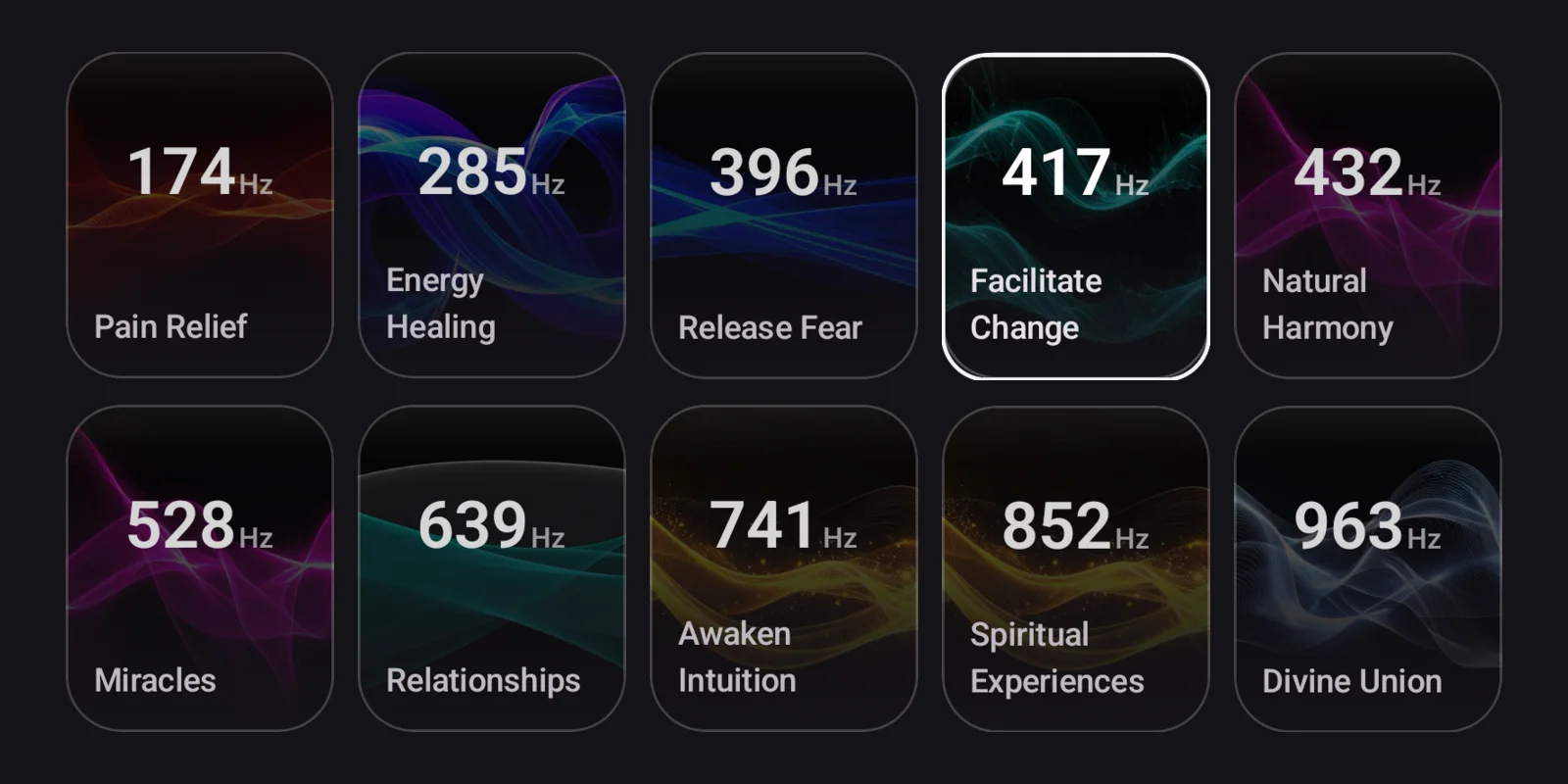
In the Brainwaves screen, every Solfeggio tile from 174 Hz to 963 Hz, 432 Hz included, starts with one tap, so 417 Hz is never more than a tap away. If you want music instead of a bare tone, try the 417 Hz Energy or 417 Hz Nebula tracks. Either way, the same routine applies: start it at the same time each night, set the timer, and let it become the cue that closes your day.
Frequently Asked Questions
Is 417 Hz good for sleep?
417 Hz is a warm, easy-to-listen-to tone that works well at bedtime, especially as a consistent cue in a routine you are trying to change. It will not sedate you, but used the same way each night, it becomes a reliable signal that the day is over and sleep is next.
What does 417 Hz do?
Traditionally, 417 Hz is called the change or undoing tone, played to clear old patterns and start something new. Those meanings are sound-healing cues, not medical facts, and the tone will not cure anything. In practice, people use it to anchor a calmer evening habit and reduce bedtime rumination.
Do I need headphones for 417 Hz?
No. 417 Hz is a single fixed tone and plays fine on a speaker or phone. Headphones are only required for binaural beats, which rely on two slightly different tones, one in each ear, to create their effect.
How do I use 417 Hz to build a habit?
Play it at the same point every night as the trigger to stop scrolling and start winding down. Keep the volume gentle, pair it with one small wind-down action, use a timer, and repeat for at least a week so your brain links the tone to sleep.